Distances in ALFALFA
The Basic Issues
Knowing distances as accurately as possible is very important in determining masses, and therefore for measuring the HIMF. For distances smaller than about 100 Mpc, peculiar velocities of galaxies cause them to differ significantly from the Hubble flow. As for many of the galaxies in ALFALFA we only have the redshift of the 21 cm line to determine the distance to the source, we need some model to calculate how the peculiar velocities will cause redshift to differ from that expected due to the universal expansion. This is called a 'flow model' and the one used for ALFALFA is described in detail in Karen Masters' thesis.
The Flow Model
The flow model consists of the superposition of the Hubble flow, a dipole, quadrupole, and two attractors (Virgo and the 'Great Attractor'). The dipole is there to allow the model to be adjusted to any frame of reference (changing frame just adds a dipole to all velocities). The quadrupole helps to account for the fact that the attractors are spherically symmetric where as in reality accretion onto over-densities probably occurs along filaments.
The above components were fit to a dataset of galaxies with known distances and velocities (tracers). The distances to tracers are from a combination of primary and secondary distance measures: tip of the RGB, surface brightness fluctuations, and Tully-Fisher relation.
Unfortunately life is never simple, and even with a flow model it is still not just a case of matching velocities to distances. The flow model can be double, or triple valued in distance for a give velocity. To help resolve this galaxies that are close to the cores of the attractors are assigned those positions, and for triple valued cases the middle value is chosen and the errors are enlarged to reach the other two possible values. All these cases are also given flags (see below).
It should also be noted that there is an intrinsic thermal velocity dispersion of the order of 200 km/s that cannot be removed. This leads to a minimum error of roughly 3 Mpc in all distances calculated by the flow model, therefore any distances under 5 Mpc should be regarded with due skepticism.
Calculating Distances
The IDL procedure for calculating distances is 'distance_catalog.pro', which in turn calls various routines written by KLM. There are 5 fundamentally different ways this program may measure the distance (plus a few variations on those 5). They are as follows:
- Primary Distances - If the source in question is found to be associated with an object for which there is a primary distance measurement (e.g. TRGB or SBF) then that distance is assigned. (Flag = 98)
- Secondary Distances - If the source in question is found to be associated with an object for which there is a secondary distance measurement (e.g. TF relation), but no primary distance, then that distance is assigned. (Flag = 93)
- Cluster - If the source in question is found to be associated with a cluster (e.g. Virgo) then it is assigned the distance to that cluster. (Flag = 92)
- Flow Model - If there is no primary or secondary distance, and the source is not associated with a cluster then the flow model is used as described above. (Flag = 94)
- Hubble Flow - If the velocity of the source is greater than 6000 km/s then pure Hubble flow is used with a Hubble constant of 70 km/s/Mpc. (Flag = 99)
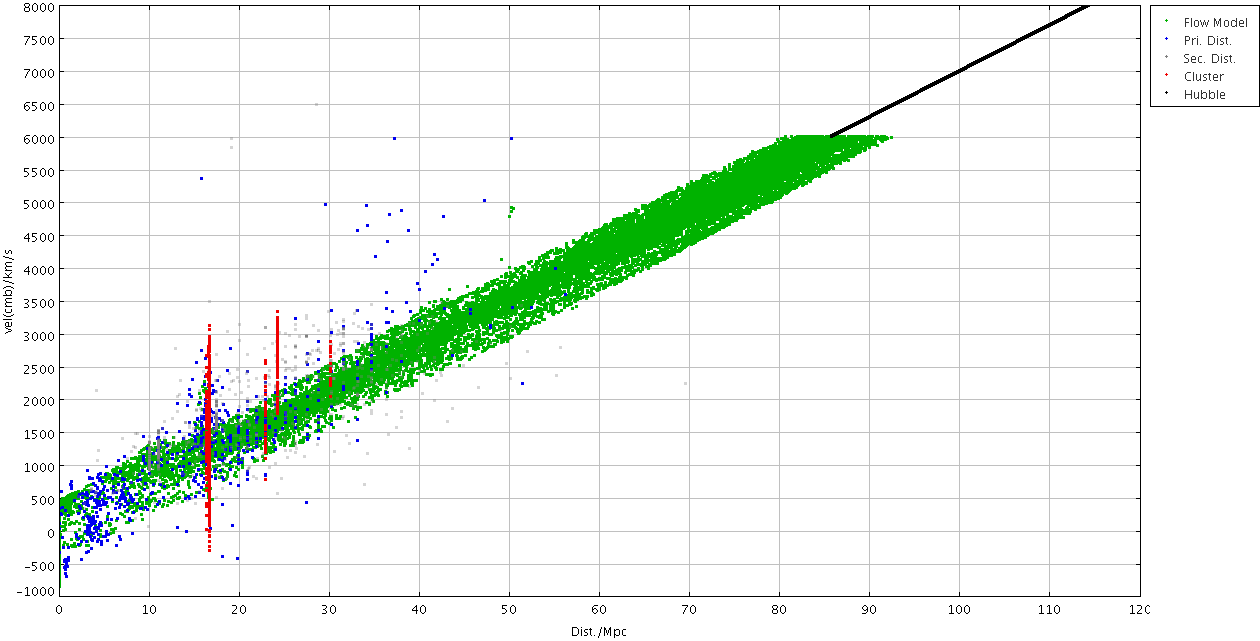
Calculated distances from a selection of AGC galaxies. Blue = Primary distances, Grey = Secondary distances, Green = Flow model, Red = Assigned to Virgo, and Black = Pure Hubble flow.